How to Take Notes From a Textbook Without Copying It
Summary
To take notes from a textbook, read one section, close the book, and write what you remember in your own words, then reopen it and fix the gaps. Survey the chapter first and turn each heading into a question. Keep notes to about a fifth of the original length, and review them on a spaced schedule so they stay useful.

Here is how to take notes from a textbook: read one section at a time, close the book, and write what you remember in your own words. Then reopen it and fix the gaps. Do this and you will remember more with less rereading. The notes are a record of what you recalled, not a copy of what the page said. Everything else, from the layout of your page to the app you use, is a detail.
I learned this the slow way. I spent a full semester highlighting chapters in three colours and ended up with pages that looked studious and taught me nothing. This is what I do now, and what I would tell anyone starting a new course.
Why does copying the textbook feel productive and teach so little?
Copying is easy to measure. You can see the page fill up, and a full page feels like work done. But your hand can move while your attention is elsewhere, and a paragraph transcribed word for word has not been understood by anyone.
The most cited review of study techniques, a 2013 monograph by Dunlosky and colleagues, rated highlighting and rereading as low utility, while practice testing and spaced review rated high. The summary published by Kent State is a readable way into the findings. The pattern is simple: techniques that make you retrieve something beat techniques that let you recognise it.
That is the whole argument for writing notes from memory. Recognition is cheap and feels like knowing. Retrieval is slightly uncomfortable and is the part that works.
What should you do before writing a single note?
Survey the chapter first. Read the title, the headings, the figure captions, the boxed definitions and the summary at the end. This takes three to five minutes and gives you a map, so each section lands somewhere instead of floating.
Then turn each heading into a question. "Cellular respiration" becomes "How does a cell turn glucose into usable energy?" You now have a reason to read the section, and you have a prompt for the notes you will write later. This is the first two steps of SQ3R, the method described in Harvard's academic resource guide, and the two steps most people skip.
How do you read a section so the notes come out useful?
Read one section, no more. A section is the stretch between two headings, usually two to six pages. Resist the urge to write while you read, because you will copy.
When you reach the end of the section, close the book. Say or write the answer to your heading question in two or three sentences. Do it badly if you have to. A messy attempt that exposes a gap is worth more than a tidy paragraph lifted from the page.
Now open the book again and check. Add what you missed in a different colour of pen. That second colour is the most useful thing on the page, because it marks exactly where your understanding was thin.
Keep the notes short and specific. The point is a page you can use later, not a page that proves you were there. A short list of what ends up in the notes:
The answer to the heading question, in your own words.
Any definition you could not state from memory, copied exactly.
One example you can explain without looking.
A single line on how this section connects to the previous one.
A question you still cannot answer.
Is the Cornell layout worth the ruled lines?
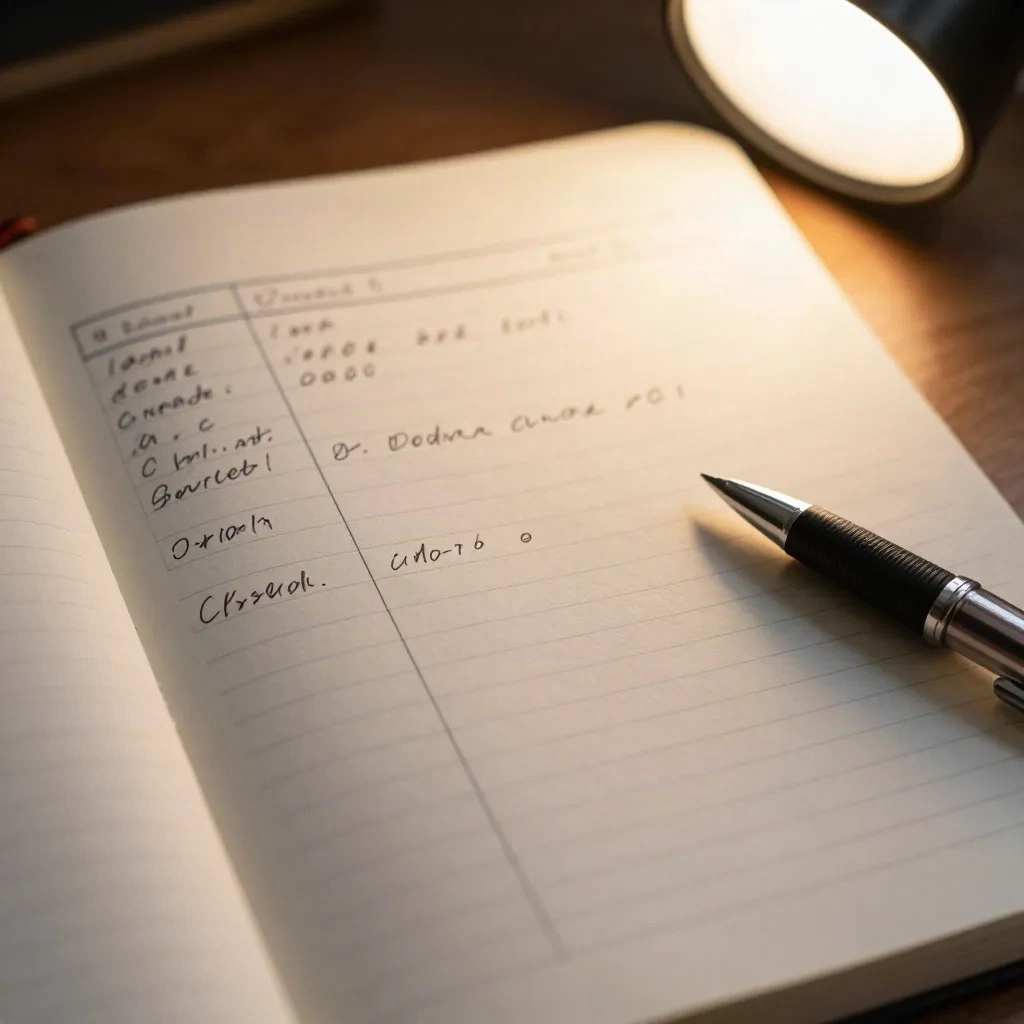
Mostly yes, for one reason, and it is not the ruled lines. The Cornell page splits into a wide notes column, a narrow cue column on the left, and a summary strip at the bottom. The cue column is where the method earns its keep.
After you finish a chapter, you write short questions or keywords in the cue column beside each block of notes. Later you cover the notes, read the cues, and try to answer. The page becomes its own quiz without any extra preparation.
Skip it if you are taking notes on a laptop and the layout fights you. A plain outline with the heading questions as parent bullets gives you most of the benefit. What matters is that the question and the answer sit apart, so you can hide one and test yourself on the other.
Should you write by hand or type?
Both work, and the usual claim that handwriting always wins is weaker than it sounds. The well-known pen versus laptop result concerned lectures, where fast typing tempts you to transcribe everything. A textbook is different. You control the pace, so the transcription trap is easier to avoid.
My rule is practical. Use paper for dense conceptual material where you want to draw arrows and diagrams. Use a laptop when the notes will be searched later, or when you need to paste in a formula or code. If you type, type slowly enough that you have to rephrase.
Digital notes deserve the same discipline as paper ones: short, rephrased, and tied to a question. A good plain-text tool matters more than people admit, because the habit survives a change of app only if the files do. Linked notes in a local folder will still open in ten years, which cannot be said for most apps.
Where do digital tools help, and where do they get in the way?
They help in three places. Search is the first: a year from now, you will not remember which chapter covered a concept, but you will remember a word from it. Storage is the second: a scanned or digital textbook can sit beside your notes. Review is the third: a tool that resurfaces old notes does the spacing for you.
They get in the way when they make capture too easy. A one-click highlight export feels like progress, and it is the same trap as the yellow marker. If you find yourself clipping more than you can ever revisit, you have built a pile, not a library.
For long digital readings and PDFs, a reader that keeps highlights and notes together can be a decent home for the material.
If you study from a stack of papers or lecture PDFs, NotebookLM can answer questions grounded in the sources you upload, which is a useful way to check your own understanding. It is a place to test notes, not a replacement for writing them.
On the question of AI summaries: they cannot replace your own notes on a first pass, and I say that as someone who builds summarization tools for a hobby. A summary tells you what the text says. It cannot tell you what you understood. If the summary is the only thing you read, you have skipped the retrieval step, which is the step that matters.
Where a summary earns its place is before the reading. Skim a 150-word summary of a chapter to build the map, then read the chapter properly. Or use one after you have written your own notes, as a second opinion on what you missed. Used in that order, it supports the habit. Used instead of the habit, it quietly replaces it.

How do you turn the notes into something you can review?
Notes you never reopen are decoration. The review is where the notes become knowledge, and it needs a schedule, not willpower.
Here is the schedule I settled on after trying several:
Review the same day, for ten minutes, covering the notes and answering the cues.
Review again two days later, only the questions you got wrong.
Review a week later, then at the start of each month before an exam.
Turn the five hardest questions per chapter into flashcards, on paper or in an app.
Spacing the reviews is the other high-rated technique from that 2013 review, and it costs very little. Ten minutes on four separate days beats an hour on one.

What do most people get wrong with textbook notes?
Four things come up again and again.
The first is writing too much. If a page of notes is longer than the page of textbook it came from, you are copying. Aim for roughly a fifth of the original length.
The second is highlighting first and thinking later. If you must highlight, do it after you have recalled the section, and mark only what you could not recall.
The third is taking notes on the whole chapter in one sitting. Attention drops after about forty minutes, and the notes from the last third are usually the thinnest. Split long chapters across sessions.
The fourth is treating the tool as the method. The notebook, the app and the colour system are the scaffolding. The recall is the building.
If your note-taking stack is already heavy with apps, a lighter place to keep everything can be worth it, especially if you want simple pages you can link and search.
A realistic first week looks like this. Pick one chapter from the course you are most behind in. Spend five minutes surveying it and write the heading questions. Read one section, close the book, answer from memory, check, and correct in a second colour. Do that for each section across two or three short sessions.
On the same day, review for ten minutes. Two days later, review only what you got wrong. That is the whole system, and it fits on one index card. If a chapter has a dense diagram or a worked example, copy it by hand once and then redraw it from memory the next day. The redraw is where you find out whether you followed the logic or only recognised the picture.
Some weeks it will feel slower than highlighting, and that is a fair description. It is slower in the moment and faster by the exam. Whether you write it on paper or in a file, the notes are only a trace of the thinking. The habit is the thing you are building.